
In Memoriam
<div id="IM20201001">

</div>
Larry hitting his famous “Turville Slice Backhand”
A Giant Passes
by Jimmy Parker
prkrtennis@aol.com
October 2020
Larry Turville of Dunnellon, Florida, died on October 10 at the age of 71 after a long battle with cancer.
Giants tend to cast long shadows, and Larry Turville certainly did that. But it wasn’t just Larry’s 6’7” prepossessing on-court presence that loomed large, but also the indelible imprint that he left on the game of tennis. Having grown up in St Petersburg, FL in a family of tennis enthusiasts, it was probably somewhat inevitable that he would immerse himself in numerous facets of tennis. His father had been President of the US(L)TA in the Sixties, and a Davis Cup Captain in the early Seventies. His older brother Ed was a member of the US Junior Davis Cup Team, and a teammate of mine at Rice.
First, Larry was a player – the #1 junior in Florida and a two-time All American at Georgia Tech. Larry began playing the nascent professional tour after graduation, and personally experienced the difficulty of gaining access to the main ATP Tour. At the time, it was hard for young players to break in against the established stars. So, he and his buddy Armistead Neely took the initiative, co-founded the first satellite circuit, and ran it for the next five years. It was called the WATCH Circuit (World Association of Tennis Champions), and was the first one to offer ATP points. All satellite circuits that have followed hearken back to that beginning.
While playing the professional tour, he qualified for Wimbledon, the US Open, and the French Open. Upon retiring from the tour, he coached the Rice University Men’s Team for the next twenty years.
But Larry did not put his own tennis racquets in moth balls! At age 35, he began playing USTA age group tennis, and ended up establishing one of the most distinguished records in US senior tennis. In all, he won 22 National Singles Championships, and 24 National Doubles titles. In addition, he represented the USA on 11 occasions in the ITF World Team Championships, accumulated five World Doubles Championships, one World Singles Championship, and the #1 ITF World Ranking in the 60 & Over.
Meanwhile, Larry’s off-court involvements in our game kept him from gathering much moss. In a bit of a déjà vu, he was instrumental in the founding and running of the Florida Super Senior Grand Prix while chairing the USTA Florida Competition Committee. It was a bit reminiscent of the old WATCH Circuit, with prize money, points, and a Grand Prix, but organized for players 55 & Over. And we geezers love it! He was then asked to serve on the USTA Adult Competition Committee, which he did for four years.
And then, of course, there is the NSMTA. Along with Steve Duffel and Jerry Thomas, Larry was one of the first ones to actually do something about forming a men’s senior tennis organization that would parallel what the women had done forty years ago. I can say without exaggeration that Larry has been one of the most creative, energetic, and valuable members of our Board of Directors. We already feel the loss, and he’s barely gone. Our hearts go out to Kelli, who has been his rock of support throughout these extremely challenging times. At a personal level, his too-soon passing makes me want to better appreciate whatever time I have left.
Click here to read A Giant Among Us: Remembering Larry Turville by USTA Florida
Winners at the 33rd annual International Tennis Federation (ITF) Super-Senior International Team Competition held Sept. 2013.
The U.S. Von Cramm team (left to right): Fred Robinson, Tony Dawson, Tom Smith, Larry Turville
<div id="IM20200201">

</div>
Florida Tennis Legend, Frank Froehling III
by Nicole Hardenstine
Hardenstine@ustaflorida.com
January 2020
Frank Froehling (left) poses with fellow American Dennis Ralston.
Copyright International Tennis Hall of Fame
Frank Froehling III, a legendary player in Florida tennis history, died at the age of 77 on January 23, 2020 in Stuart, Florida. Froehling, whose full name was Frank Arthur Froehling III, had been battling chronic lymphocytic leukemia for several years.
The Florida legend, who was raised in Coral Gables, was a college standout at Trinity University in Texas. During his college career he recorded 46-5 in singles matches and won nine singles titles.
From 1961 to 1971, Froehling was a mainstay on the U.S. top 10 men’s circuit. At just 21 years old, he was runner-up at the U.S. National Championships at Forest Hills in 1963, making him the first American to reach the final round of the championships since 1955. Despite being unseeded, he defeated Australian Roy Emerson to advance to the quarterfinals, where he snuffed out the UK’s Bobby Wilson and Brazil’s Ronald Barnes before losing to Rafael Osuna in the final. That same year Froehling was ranked World No. 6. He was also a runner-up in the 1965 U.S. Nationals Championships doubles competition and a two-time runner up in the mixed doubles competitions held in 1962 and 1965.
Following five years off to pursue corporate endeavors, he returned to the tour in 1970 and eventually reached the 1971 French Open where he reached the semifinals after a victorious win over fellow American phenom Arthur Ashe in the quarterfinals. He was also part of the 1971 U.S. Davis Cup team, where his win over Ion Tiriac in five sets helped lead the U.S. past Romania in a challenge round.
In 1981 Froehling’s legacy was cemented into Florida tennis history when he was inducted into the Florida Tennis Hall of Fame as part of the first-ever class alongside Chris Evert, Doris Hart, Gardnar Mulloy, Edward Turville, and Clarence Varner.
After retiring from the tour, Froehling had won numerous senior events and was named the USTA Florida Section’s Male Player of the Year in 1997. He also won five national Father-Son championships with his father, Frank II. In his retirement, Froehling’s mission for several years was to improve the quality of tennis in communities throughout Florida, through a court construction business that built more than 5,000 courts across the state.
Friends and family say Froehling will be remembered for his kindness, candor, humor, loyalty, work ethic, legendary competitive spirit, unusual generosity, and his contributions to the tennis world.
Photo courtesy Modern Tennis
Methodology Coaches Association
<div id="IM20191001">

</div>
Lorne Main - Canada’s Best
by Mark Winters
mwinters@nsmta.net
October 2019
Lorne Main Photo Courtesy British Columbia Sports Hall of Fame & Museum 1975
Naming Canada’s best player from the “good old days” – the pre-Open Tennis Era – some National Senior Men’s Tennis Association members might suggest Don Fontana, Keith Carpenter or perhaps Bob Bédard. Mike Belkin, Tony Bardsley and Harry Fauquier’s career might also be parsed, so to speak. Don McCormick and Bob Puddicombe are additional standouts who could receive mention. While each of these competitors had notable careers, tennis historians would be unlikely to select even one of the aforementioned individuals.
The reason is simple. No one was more remarkable than Lorne Main. For many in the game, the British Columbia native, who passed away October 14th at 89 in a Vancouver hospital, was the top men’s player in Canada’s tennis history.
When he began to play as a nine-year-old, at Oak Park in Vancouver, Main was small. (He eventually grew to be five feet, eight inches tall.) The late Bud Collins, the 1994 International Tennis Hall of Fame inductee, in his epic book “The Bud Collins History Of Tennis”, called attention to the fact that “Lorne Main was the inadvertent father of the then rare two-way, two-handed style, both forehand and backhand.” He explained the reasoning behind his adapted style of playing tennis to Collins saying, “Seemed natural to me as a boy since I was a baseball switch-hitter.”
Main opened the door and held it, naturally with two-hands, for Monica Seles, Fabrice Santoro, Marion Bartoli and Gene Mayer who have since been feted for playing shots with two-hands off both sides. In “A Senior Legend - an interview with Canadian tennis champion Lorne Main”, a SeniorsZen story posted July 18, 2017, he admitted never really having a coach because “Nobody plays that way.” He went on to point out that he played tournaments, (Davis Cup and even in 1949-50 when he was at University of California, Berkeley), two-handed, but when he moved into the senior ranks, he became solely a right-hander.
Main was Canada’s top junior between 1946 and 1948. In 1949, he earned a Top 5 men’s national ranking and remained among this elite group until 1958 (He was No. 1 in 1951, and again from ’53 through’55). He became a member of the Davis Cup team in ’49 and concluded his involvement in 1961, (He was the non-playing captain from 1958 until ’61).
With all his on-court successes, Main’s 1954 Monte Carlo victory has been called the most significant title won by a man from Canada prior to Open Tennis. In the final, he defeated New York’s Tony Vincent, 9-7, 3-6, 7-5, 6-4. (Vincent was again a finalist two year later dropping a 1-6, 8-6, 6-0, 6-2 decision to Hugh Stewart of Los Angeles.)
As important as the Monte Carlo victory was, there was more that made the year stellar for the 24-year-old. He reached the round of 32 at Roland Garros, Wimbledon and the US Nationals. All in all, 1954 was memorable for the affable star who was a marvelous recounter when he was visiting with anyone in and around the game.
It may seem hard to believe after his many years of competitive consistency on the circuit, he became even better as a senior. After his days as an amateur, he worked in magazine and newspaper advertising but remained formidable on the court. As an International Tennis Federation (ITF) stalwart, Main was ranked No. 1 in age divisions from 55 to 80. In the process, he claimed 12 ITF singles and 13 doubles trophies (12 with Ken Sinclair and one with Gordon Verge). He teamed with Sinclair to lead Canada to ITF World Team Cup triumphs in 55 to 80 competition.
Main was so exceptional that at the 2012 ITF World Champions Dinner, held annually during Roland Garros, he received the Outstanding Services to Senior Tennis Award. It was fitting that Main, who became a member of the British Columbia Sports Hall of Fame & Museum in 1975 and was inducted into the Canadian Tennis Hall of Fame in 1991, was duly recognized. In addition, he became a member of the prestigious International Lawn Tennis Club of Canada in 1961.
Throughout his career, Main enjoyed tremendous respect from the tennis community at large and from his fellow competitors. When Jim Perley was inducted into the Southern California Tennis Association’s Senior Hall of Fame in 2014, he said, “I really enjoyed playing on all of the ITF Cup teams. The competition was always challenging, the locations were great and I have a lot of fantastic memories.”
He continued, admitting his fondest recollection was, “I played Lorne Main, Canada’s best player, in the ITF Men’s 65 final. I won the first set, 6-1. He took the second, 6-1 then I won the third set, 6-1. It was my first World Championship, and I don’t know if anyone has had a match like this?”
Especially, a match against Lorne Main. The game lost a legend on October 14th but in his absence everyone will remember that he was a very special and unique individual.
(The National Senior Men’s Tennis Association extends condolences to his family, including children Kelly, Kevin, Kristine and Kasey whose mother, Ivy, preceded him in death, and to his widow, Adrienne Avis, the Australian tennis star, who he met at the ITF World Championships in 2010 and married in 2016.)
Lorne Main Photo ITF Seniors Player Profile
Lorne Main Photo ITF Seniors Player Profile
ITF President Francesco Ricci Bitti and Lorne Main at the World Champions Dinner Photo Courtesy of ITF
<div id="IM20190901">

</div>
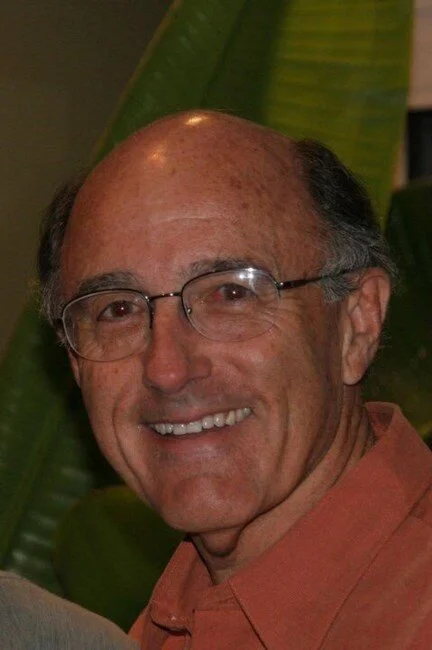
Remembering Ralph Grieco
by Hugh Thompson
aht345@gmail.com
September 2019
The tennis community suffered a tragic and unexpected loss the last week of August when Ralph Grieco passed away in Pompano Beach, Florida.
Ralph and I played together, against each other and practiced together for 24 years. In the late 90’s, we played at Ansley Golf Club in Atlanta almost every Monday afternoon for close to seven years. Recently, we had been practicing together two or three times a week, and in typical Ralph style, he was helping me rehab my game after an injury. He was always helping other people achieve their goals, and he never asked for anything in return. At the same time, he was always grateful for any help offered to him.
In all the time we were on the court, I never remember Ralph being anything but a great competitor and a very fair opponent. He had his priorities in order – God, family and then tennis. He was passionate about photography and anyone who played a tournament he was in, saw themselves in a photo montage more than once. I will miss the photographic history of tournaments that he would have recorded in the future.
Another passion Ralph had that few people were aware of was that he and Kristi had eight (yes, eight) house cats, each with a unique story of how they joined the Grieco family. Anyone that will be “house daddy” to eight rescued cats is, in my opinion, a person of great stature.
A caring, compassionate man, Ralph was instrumental in tying together the NSMTA and needy local tennis organizations at some of the larger national events. He went to the NSMTA board and suggested that many of the players would likely be happy to give back to the great game of tennis that had treated all of us so well. He was right and several tennis organizations have benefited from his vision.
An excellent player, but a more wonderful person and a great friend, he is another sad loss to our community this year. Steve Powell, Richard Johnson, Eben Hardie, Dale Quigley, Woody Hoblitzell, Hersh Herschman and now Ralph Grieco have left us saddened with their departures.
For those of us that remain, be thankful for every new day we have been given. Remember to tell our loved ones and acquaintances how much we appreciate them, because we have no guarantee that we or they will be here tomorrow.
When Ralph and I were practicing two weeks ago I never expected to be writing about this tragic loss to our tennis community.
<div id="IM20190801"></div>
Dennis Van der Meer Defined Innovative Tennis Instruction
by Mark Winters
mwinters@nsmta.net
August 2019
Attempting to explain the impact Dennis Van der Meer had on tennis is next to impossible. He did so much for so long that his accomplishments as an instructor overwhelm definitive record keeping. Not attempting to be cliched, the “Game’s Einstein” passed away on July 27th at the age of 86, in Hilton Head, South Carolina. (He had been in ill health for a lengthy period of time.)
It is often said “if you can’t play really well, you should teach.” That is basically what happened with Van der Meer. He was born in Namibia to parents who were South African missionaries and raised in the Cape Town area. He became good enough to be invited to try out for South Africa’s Davis Cup team. In his candid fashion, years later he admitted to “choking.”
Self-doubt stalled his high level competitive career, but at the suggestion of a coach he began teaching, in order to restore his self-esteem. Not only did he blossom, he excelled in his new profession. For those in the tennis industry who knew him, the idea that Van der Meer, at any time, lacked confidence is really difficult to grasp.
It seemed that the bigger the stage, the more dynamic he was. He could be boisterous and bossy (and this I know from personal experience). On court, he was “The Boss.” He was strict and could, on occasion, be crusty when offering an opinion regarding an instructor’s teaching skill and/or playing ability.
But, away from the court, he transformed. He became engaging and entertaining, often telling wonderful stories. He was quick witted, humorous and from time to time, self-deprecating. Actually, he was captivating wherever and whenever.
Van der Meer arrived in the US in 1961. He began teaching at the Berkeley Tennis Club in the eclectic City by the Bay. Eric van Dillen and Jeff Borowiak were among the elite juniors he guided. He also worked with Billie Jean King and Margaret Court, too. But, he was truly in his element dealing with youngsters under ten, who were just beginning to play.
He did it with off-the-charts creativity. Because of the court restrictions he often faced, he used ropes to divide a single court into play areas and involved the kids in games in which they realized success.
As a teaching professional who worked for him for ten years said, “He taught kids how to learn tennis…and they had fun doing it.”
He regularly invented methods to develop proper stroke technique. One of his all-time best was a way to help those who opened up too soon, pulling the elbow away from the body, when hitting a backhand. To correct the error, he had the player place the top from a metal tennis ball can, (yes, this was in the old days), under the arm pit. If the player opened up too soon, the top dropped, and clattered on the ground. Keeping the elbow tucked appropriately produced a clean stroke and the top would drop as the ball was struck.
In 1963, he married Linda Vail, a talented player from San Francisco, who is one of only five women to sweep the National Collegiate titles. In 1960, competing for Oakland City College, Vail claimed the singles championship and teamed with Susan Butt of University of British Columbia to take the doubles. The year before (1959), she was a Wimbledon competitor. Over time, she became better known for her relationship with the rising teaching star and the fact that they had a Cheetah named “Drop Shot” that they kept at their home. (They divorced in the 1970s.)
He teamed with King to start Tennis America. Under that banner, the organization held summer Van der Meer-King Tennis Camps at the Incline Village Tennis Club on the shores of Lake Tahoe, Nevada. Always a keen observer he soon realized the instructors who were working for him didn’t use similar approaches. One taught one way, and another went about teaching in a completely different fashion.
This led Van der Meer to launch Tennis University. It focused on establishing a Standard Method of Teaching (SMT) the game. In 1976, he founded the US Professional Tennis Registry (USPTR) that has become the Professional Tennis Registry (PTR). It is acclaimed nationally and internationally for certifying teaching professionals who utilize the instruction format he developed.
Around this time (in the ‘70s), he moved his operation to Hilton Head Island, South Carolina and opened Van der Meer Tennis University. He worked constantly to inform the tennis community about the importance of standardized teaching. During one of his presentations in 1980, a clinic attendee caught his eye. In truth, it did more than that since the individual was not only striking, but a former player who had decided to become a certified instructor. That special lady became Pat Van der Meer in 1981.
During his career, he received more accolades than a head of state. He was named Tennis Coach of the Decade in the 1994 Tennis Buyers’ Guide Readers Poll; Development Coach of the Year, US Olympic Committee in 1997; US State Department Exceptional Coaching Performance in the Middle East in 1972. He has receive countless other tributes, but the most meaningful was becoming the first PTR Hall of Fame inductee in 2013.
In 2011, at 78, he suffered a debilitating stroke at Hilton Head. In life and love, what comes around regularly goes around. Pat had been critically ill years before and Dennis nursed her back to health. For the past eight years, she has done her utmost to make his life fulfilling. (She was by his side at the PTR Hall of Fame ceremony.) Together, they worked even harder (because of his incapacities), on ways to make wheelchair tennis more rewarding to play. Until the end, they shared over thirty years of special memories…
While Dennis Van der Meer was bigger than any story that can be told about a tennis educator, Pat played a critical role in making the book a bestseller. Her importance should be recognized as the deserved tributes are paid to the individual who defined innovative tennis instruction.
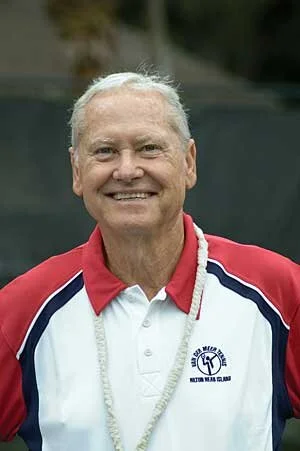
Dick Johnson
by David Nash
ballsogold@comcast.net
May 2019
On Monday, April 8, I awoke to the news that one of my best friends, Richard (Dick) Johnson, had died in his sleep. This is a huge loss to so many. Dick’s wife, Liz, lost the love of her life. Dick was a father, grandfather, coach/teacher, a son-in-law, and a friend to many. The tennis world lost one of its most legendary competitors. We are all stunned and sad.
A week ago, Dick and Liz spent five days with us in Florida. Typical of tennis players, we discussed old matches, and I asked him, “What would you say were your most memorable career moments.” Dick was typically humble, but he shared some great stories. Dick was looking forward to playing a National Tournament in May and planned to join Jimmy Parker, a long-time friend and competitor from St. Louis, at the World Championships in Croatia. His only dilemma was how he would manage to juggle his tennis and pickleball tournaments (a recently acquired sport where he had already won a National title.)
He was born in Rockford, Illinois, but lived most of his life in St Louis, Missouri. He played tennis for Kalamazoo College and Western Michigan University. He spent a year on the tour but gave it up to become a teaching professional. He recently retired as the head tennis professional at the Country Club of St. Louis. In 1997 he was named to the Missouri Valley Tennis Hall of Fame.
Dick loved tennis and was a fierce, classy, well-respected player. At age 74, he looked and moved like a much younger player. Throughout his life he spent most of his vacation time competing in tournaments; locally, nationally, and internationally. As a singles player, he was consistently ranked in the top four in his senior age division, but he was especially known as a brilliant doubles player. Every player felt confident and lucky to have Dick as a partner. I was fortunate to share the court with Dick numerous times. He earned over 60 gold balls, the coveted award for winning a National tournament. Since the 1980s, almost every year, Dick was elected to the U.S. team participating in the ITF World Team and Individual Championships. In 2015, Dick won the senior World Singles Title in Croatia, gaining his highest ranking ever. Dick participated in tournaments throughout the U.S. and across Europe, competing in England, France, Germany, Austria, the Czech Republic as well as South Africa.
We will miss him immensely and treasure the good times we all shared with him.