
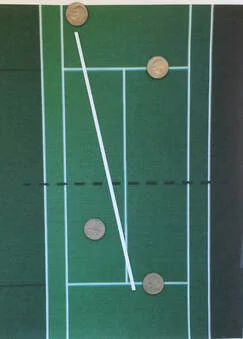
You are serving in a doubles match in the deuce court and the returner hits a ball over the middle that lands just beyond the tee on your side of the court. Should your net man have taken the shot … or is it the incoming server’s ball to take? (The incoming server is lower-right in the picture).
Difference of Opinion
I was playing a practice match with a seasoned senior tournament player (who shall remain anonymous – unless he wants to identify himself in a comment below); and that situation happened. He was at the net and let the ball go for me to take as I was following my serve to the net. So I lunged for the low backhand and missed the shot.
On the changeover, we discussed the philosophy of “Whose Ball is It?” His guiding principle is that any ball that eventually lands on the server’s half of the court is the server’s ball to have played. My feeling is that for that ball to come from the deuce court to just my side of the tee, means that it had to cross in front of the net man — and he could/should close in and pick it off.
The Bryans
I remember watching a Bryan brothers’ video where they said: if your incoming serving partner has to lunge for a low back hand (or forehand) over the middle, it should have been the net man’s ball to pick off.
My partner feels that he has to watch out for the returner to hit a ball down his alley and it would then be the server’s job to cover the middle.
Six Shot Options
I figure that the returner (assuming all players are righty) has six return options…
Down the net man’s alley
At the net man
Over the net man
Down the middle
At the incoming server
Cross court toward the server’s alley
My partner believes it is the net man’s job to cover 1-2-3 and the server 4-5-6. But I don’t believe either player can effectively cover for any more than TWO of those options. So unless the serve was very wide to the returner’s forehand, my priority for the net man would be to cover for the hard one at him and the ball over the middle (and be able to take the short lob over his head) – while “challenging” the returner to try to go over the high part of the net down his alley.
My priorities for the incoming server would be to cover the ball at him and wide one towards his own alley (and be ready to cross over and take a deeper lob over his net man’s head).
What do YOU think?
Noted Passing: Veteran senior tennis player Dick Johnson died on April 8th. Those who knew him say that in addition to being an excellent tennis player, he was a fine gentleman.
Know someone who should read this? Send them a link and if you are not on my “new posting alert email list” and want to be (I promise, no other uses of your email address!), just drop me a note at GeorgeWachtel@gmail.com
Thoughts on “Whose Ball is It?”
Bill Plummer
As a lefty I want that ball. But speed, topspin comes into play as well. I want my partner to make sure that forehand return down the line is covered. A shoulder high return I would like to see my partner close on the volley.
Bill, for the lefty, the same situation would happen in the ad court. Thanks, george
Winder Bill
The answer could be some what-ifs involving a) how forcing a serve that gives the returner more or less high percentage return options b) the returner’s known predilection for go-to returns c) the net person’s mobility, volleying and overhead skills
d) the server’s mobility, skill set with serve and volley or not. It would be easy and correct most of the time to say that the diagrammed flight of the return calls for the net person to volley it and I would not even call that a poach.
However, if I am playing against a really excellent lob returner on down the tee serves in the deuce court who also can handle my wide serve down the line with consistency, I would ask my partner to play deep enough in the box so could not make that otherwise routine volley or I would serve in “Australian” formation.
Winder, i agree with all your “if’s” and also with your “most of the time” conclusion! thanks, george
Chris
It’s a little tricky. As a server I assume everything is mine unless discussed/signaled beforehand. As the net player I try to go for everything possible but I do find more of those types of returns get past me as I am not as quick as I used to be.
I’ve also noticed that returns that I would have classified as weak 10-20 yrs ago are surprisingly effective now.
Chris, slowing down is one of the key factors that makes that low return increasingly challenging for the incoming server. And as a net man, i tell myself “the return is mine,” unless i cannot get to it. thanks, george
Alan Anastos
I believe that whoever is closer to the net (obviously in this case it’s the net man) should take it…IF he doesn’t have to challenge himself with a difficult play on the return due to the velocity and/or spin and the degree of angle at which it’s hit. Looking at your diagram, if I was the server and you, my partner, let that one pass you by and we then turned to watch the ball land where indicated, I’d slap you five and tell you “That one’s yours partner”. (and I’m a lefty)
Alan, i am with you! george
Winder Bill
Dick Johnson passing – it was my privilege to interact with him at several senior tournaments – clearly one of the real quality people on the senior tour – he is on my list of singles opponents who I played while healthy and hitting well and who absolutely crushed me – the talent level was a complete mismatch. His focus on every shot, every point was total and his understated, affable attitude during and after the match was appropriate and enjoyable. Had no idea he had terminal health issue – will miss him.
Joel Drucker
Great question, George. Assuming these are two righties, I suppose the net man could give it a go, especially before the ball dips too much. After all, of his three areas of responsibility, they are not equal, as he should put far more energy into visually pinching the middle than worrying about the alley.
Of course, as a lefty myself, that could also be my forehand volley too. For that matter, in the ad court it would be my backhand volley — and that’s fine too. Through all of this, though, here is a motto I have: Please, no heroic poaches, no excessive lunging — especially when the score is 15-30, 30-30, 30-40. To the net man: Please retain your faith in your partner’s ability to hit a reasonable first volley.
Joel, i have been preaching “pinch the middle” for years! thanks, george
Terry F.
When I’m the net-man I will cover the alley on a wide serve. On a body or T serve I will look to knock off anything I can reach – especially a ball like the one you describe that is passing through my air space (even if it may land in my partners half of the court).
When I’m serving I want my net-man to cover my backhand as much as possible with his forehand.
Terry, i agree… the wide serve is a different issue. thanks, george
Billy Scruggs
Dick Johnson was a friend to not only me but everyone who knew him. He died in his sleep on Monday morning April 8 at his home in Ballwin, MO. Dick had hip replacement surgery in January of this year, and he had started back playing tennis. He was going to play the national 75 hard court championships in California this coming May. Please put Dick’s family in your prayers as they try to recover from their heartbreaking loss.
Jack Lease
From Aruba: I always tell my partner that the first one that can reach the ball should be the returner. Keep it simple.
Jack, congrats… my first Comment from Aruba! george
Lturville
I get to claim partial credit for this discussion as I was George’s partner when the issue came up. I would encourage my partner to crowd/pinch the middle, but to me the person who has to cover the middle is the person who is cross court (cc) to the ball. You give away the cc dipper angle until you get burned a few times. Take away the middle and see what they can do. Then take away their favorite shot. If a good player has ability to hit all shots, dtl, cc, middle & lob, you may need to give up the net and stay back. The fun part of doubles is if you can come up with a strategy that takes away what your opponents are good at. Then your chances of winning are much better.
Larry, always good to play with — and debate with — you! thanks, george
Michael Fenster
When I am playing net I try to go for anything within reach, both in deuce and ad courts.
If I have a partner who is a strong server, I will try to poach as much as possible which makes the returner consider that in his, or her, returns of serve.
When my partner and I use signals, (like with you, George), it always makes the returner think twice about the return.
Michael, another “Bryanism” is: “make them feel your presence.” thanks, george
KB
Winder covered it well. For me, though, if I had a doubles partner who would get to the net on his serve, I’d do whatever he wanted.
Very sorry to hear about Mr. Johnson. Hearing about way too many of those of late.
Spike
George, If I am at the net, it is the server’s ball. If Joe is at the net, he can take it!
Spike, delegate, delegate, delegate! george
Marty Judge
George,
I think both you and your netman partner are being too rigid in your respective understandings of whose ball it is to take. He is right that he should be covering the down the line shot, which makes it therefore harder for him to cover the middle. But you are also right that if he has a decent play on a ball up the middle, he should not hesitate to take it. And you should also be tracking the return a bit better and not relying on the assumption that 100% of the time your netman partner is indeed going to be in position to get that up the middle shot. We are all senior players, after all. We don’t move or react with the same lightening reflexes that we once had.
That being said, when the Bryan brothers talk about this, they are also doing so with a lifetime of experience together so you cannot expect to mimic the same coordination that they have developed with an occasional partner of your own — even if he is a good senior tournament player.
Also, the Bryans are constantly running predetermined PLAYS with each other that reduce the unpredictability of the situation and make it more likely than not the ball is going to be coming back to them from their opponents in a certain direction, with a certain amount of pace and spin. In fact, the Bryans are THEMSELVES creating or controlling these patterns of play by virtue of the distinct plays that they are running. You do not talk about running plays with your partner at all, but you really should be doing that to maximize your collective ability to get to balls that put your opponents in difficult positions.
In other words, play more like a team un accordance with the logical percentages and not as two individual players bickering over whose ball it should be in any given situation.
Marty, we weren’t “bickering,” but discussing the logic of the situation. And yes, i am a big believer in communicating and moving at the net. thanks, george
John Bradbury
Playing the percentages, I think the server should forget the sharp crosscourt into his doubles alley, and the net man should not overly consider the down-the-line return. I.E. play the percentages, and that means clogging the middle, so, in this example, it was the net man’s ball….sorry, Larry.
John, i always say, “better to have two racquets colliding over the middle than both watching the ball go bye.” thanks, george