Review by Jimmy Parker
March 2019
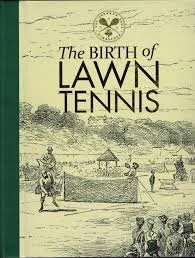
The Birth of Lawn Tennis is probably the heaviest tennis book you’ll ever pick up! Weighing in at more than seven pounds, it can also be used for bicep curls in the off-season. It comes in a leather-covered slipcase and lives up to its heft and lush feel with an abundance of rich pictures and illustrations, and thoroughly impressive research into the origins of our game. This tome cries “seminal” from the time you lay your hands on it. Only 500 copies were printed.
There has long been controversy over who really invented the game of lawn tennis, what the original rules were, where it was first played, and how it evolved into the game we know today. The co-authors, a Brit and an American, are tennis historians of the first rank. They have rectified many inaccuracies that have accumulated over the years by going back through archives of newspapers, books, periodicals, and patents of the 1870’s and before. After all, early versions of “tenez” had been played and bet upon in the courtyards of castles as early as the 12th century. We learn that Major Walter Wingfield did indeed come up with the game of Sphairistike or Lawn Tennis which he patented in 1874.
At the beginning, there were several versions of the game being played. And there were some really quirky rules. Did you know that a two-bounce rule was considered? You may have known that the early shape of courts was that of an hourglass - narrower at the net than at the baseline. The net sagged dramatically in the middle, similar to the game of Real Tennis, or Royal Tennis, or even Court Tennis (depending on what continent was occupied), which are still played today.
Eventually, the rules were standardized, and the first Wimbledon was held in 1877. The game had already spread across the Atlantic, and the authors delve into who brought it to the US (Was it Mary Outerbridge, or is that a myth?). What was the first tennis club in the US? Both Longwood Cricket Club and New Orleans Lawn Tennis Club claim to be the “oldest”. And, who first played the new game in the New World?
The amount of detail in the book is extraordinary! Never again will you have to spend restless nights wondering what grip(s) Spencer Gore, the first winner of Wimbledon, employed. (It was a Continental.) Or what his family motto was – “Under this sign thou shalt conquer”. Seems to have worked for Spencer. Or that when he won in ’77, he advanced to the net regularly and was hard to pass with the net being so high at the sides. But lo and behold, in 1878 Frank Hadow beat Gore in the final because the net had been lowered at the sides, and Hadow befuddled Gore by deftly employing passing shots along with 17 lobs. Also, Gore, described as a “natural genius for all games,” might not have been “match-tight” because he had advanced directly to the final as the previous year’s champion without having to play any matches… (Which was a tournament practice for many years.)
And if you’d like to know the story behind each of the 22 players in that inaugural Wimbledon, you’re in luck. Or if there are questions about the early tennis “implements.” Or what ever happened to Wingfield’s gold watch? There are 18 chapters and an Appendix filled with new and interesting material. As you can infer, the amount of research by Everitt and Hillway was prodigious!
While, it’s hard to do justice to the 562 pages in a short review, the book is a treasure. And like many treasures, it may be hard to find. But as is the case with many treasures, if you do manage to locate a copy, you’ll be fortunate indeed!