
To some extent, the great players of the pre-Open era have gotten lost in the mists of time. Today, many of the great players of the past are little known to today’s tennis fans, and even most of the players. Don Budge, Jack Kramer, Lew Hoad, Ken Rosewall, and Pancho Gonzales are fading memories, great as they were. This book attempts to remedy that by impressing upon us how truly impactful a player as far back as the Twenties was on the game as it’s played today. With voluminous research, the author shows that Bill Tilden was truly a colossus of the time in a number of significant ways. Babe Ruth, Jack Dempsey, Red Grange, Bobby Jones, and Bill Tilden were all in a select class of athletes. They were men who dominated each of their sports. Tilden was the first to put tennis squarely in the limelight.
I was impressed with the range of Big Bill’s excellence. Not only was he the dominant player of his generation, he was also a prolific writer of instructional books, as well as novels, and plays. His cerebral approach to the game was groundbreaking. (His book, Match Play and Spin of the Ball, is still considered a classic.) He wrote numerous newspaper and magazine articles on the game, coached several young proteges, and travelled extensively, giving clinics and exhibitions, mostly free. And always, almost no matter what he did, he incurred the wrath of the United States Lawn Tennis Association (USLTA) fiefdom with its outdated ideas of what it meant to be an amateur.
Big Bill didn’t really begin to hit his stride until he was 27-years-old. Up until that time, he was known as a player who had flashes of brilliance mixed with episodes of going off the rails. He did reach the finals of the US National singles in 1918 and ‘19, only to be overpowered by popular, diminutive “Little Bill” Johnston in the latter. Little Bill’s powerful western forehand inflicted heavy damage to Big Bill’s weaker backhand.
Big Bill, born into a wealthy family in Philadelphia, had the economic freedom to spend the winter beefing up his backhand. When he came out in the spring of 1920, he occasionally misfired with it in matches, but he was fast learning how to make it work. He had a truly all-court game – heavy artillery from both sides on groundstrokes, a powerful and versatile serve, a variety of spins, a delicate touch, and an array of finishing volleys. He won the US Nationals defeating Little Bill with his powerful backhand wreaking havoc. He then went on to win the title a total of seven times.
The author, with substantial input from tennis historian Richard Hillway, paints a different picture of Tilden than a previous biography written by Frank DeFord in the 1970’s. Hornblum is very positive in his treatment of Big Bill and quotes extensively from articles of the time which describe him in glowing adjectives. The energy of the man was beyond belief. He might play two 5-set matches in a day, write an article after he returned to his room, and then appear in a play in the evening! After he turned pro and was barnstorming and running the tour, he would often play a singles and a doubles in the evening, then drive all night to the next town to get things organized.
Throughout his tennis career, Tilden treated a tennis match as a performance, arriving for matches in a long wool overcoat with a dozen racquets under his arm. He would shout “Peach!” when his opponent hit a winner, he would berate linesmen and would even throw points ostentatiously when he thought his opponent had gotten a bad call. Early on, these were not particularly endearing habits, but as he got older and people realized his gravitas, he became more popular.
But always there has been a black cloud that has been hung over Tilden’s career. In his fifties, he was convicted of molesting a minor, and sent to a prison farm for several months. Upon his release, DeFord portrayed him as a broken man. Hornblum (and Hillway) on the other hand, interviewed many people who knew him at the time. Rather than being an ill-smelling bum, penniless and selling his trophies to live, the author found that Tilden continued to play, teach, and take his friends to dinner. Always well-dressed and upbeat, he often gave away trophies to his many friends in Hollywood – some of whom sold them.
When Tilden was 50, he volunteered to play a practice match with Jack Kramer to get Jack ready for the Nationals. He beat Kramer in straight sets. Kramer went on to reach the final, and three years later, won the US Nationals. (Now the US Open) Truly amazing! Big Bill died a few years later, resting before going out for dinner, in a coat and tie, bags packed for another cross-country tennis journey…
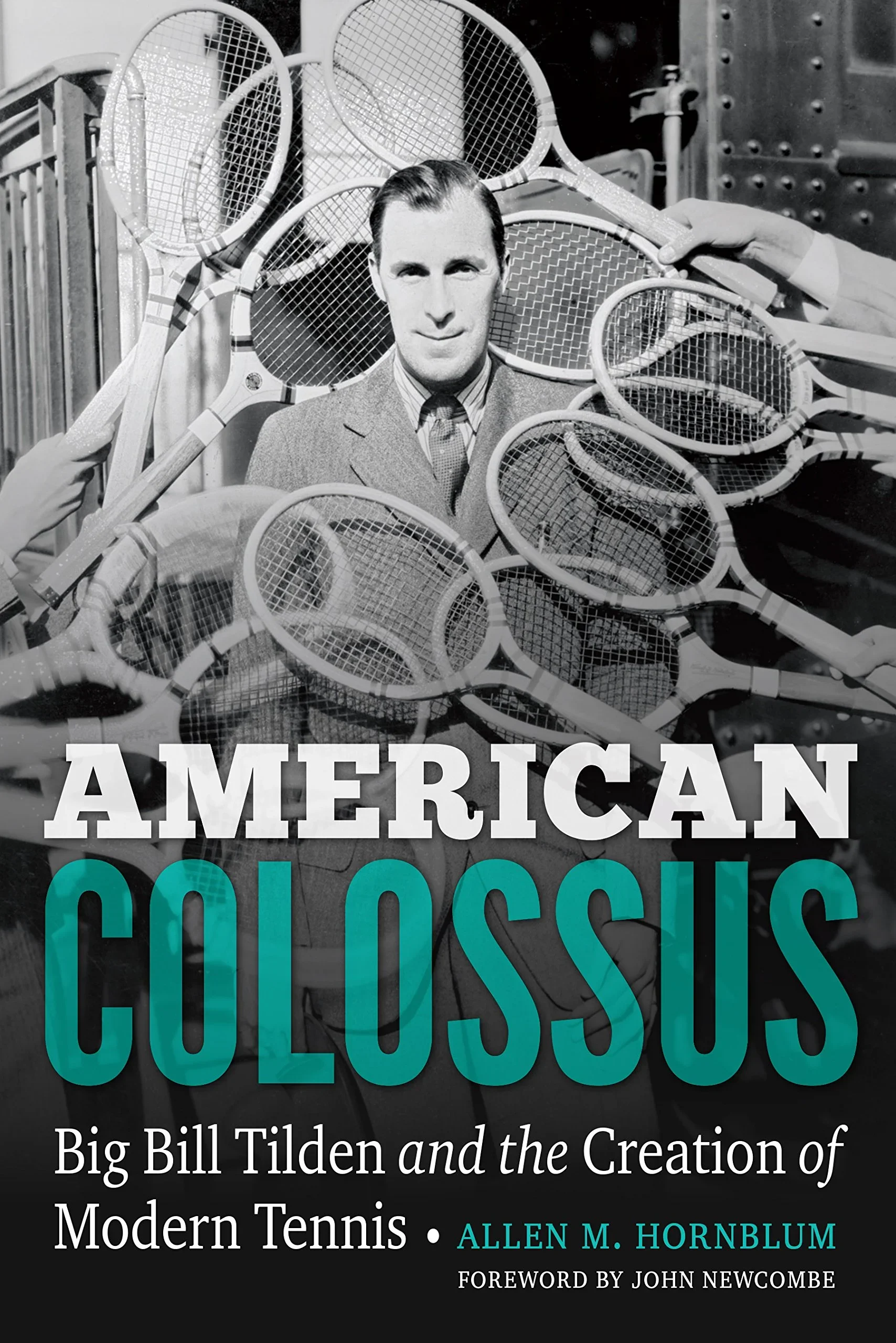
American Colossus: Big Bill Tilden & the Creation of Modern Tennis By Allen M. Hornblum









Previous
Previous
The Birth of Lawn Tennis By Robert Everitt & Richard Hillway
Next
Next