Review by Jimmy Parker
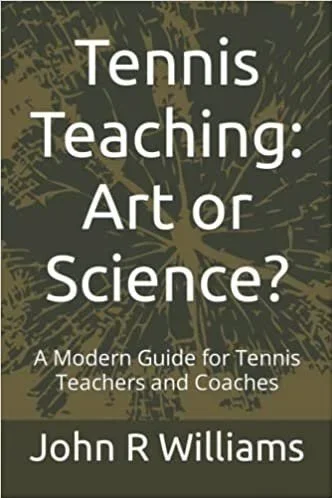
Tennis Teaching: Art or Science? A Modern Guide for Tennis Teachers and Coaches By John R William
John doesn’t waste much time in answering the question that the title of the book poses! In the very first sentence of the book he states, “The ideal tennis teacher is an artist making use of current science.” There you have it, folks – no need to read further. However, if you do indeed continue reading, you’ll be rewarded with a wealth of knowledge gleaned from the author’s many years of playing and teaching at a high level.
Anyone who has taught tennis or taken lessons from a savvy pro knows that the process of learning the game is a creative process. Both on the part of the student and the pro. Pros who are wise in the ways of getting feedback from their students understand the uniqueness of each student. I love John’s emphasis on the fact that the teacher must himself or herself be a lifelong learner.
Having been around the game for so many years, John has seen dramatic changes in the way the game is played and taught. For instance, he points out that prior to 1974 and Jimmy Connors and Chris Evert, there were very few two-handed backhands. Today, 98 out of the top 100 women and 85 of the top 100 men hit two-handers. That’s just an example of one of many ways that tennis has evolved, requiring teachers to evolve as well.
Years of experience have enabled Williams to sort out many of the conundrums of the game. For instance, he deals with the relationship of the conscious mind and the subconscious in easy-to-understand language. Many are the players who have floundered in the shoals of match play and competitive tennis because they never quite mastered the mental and emotional aspects of competing.
Another aspect of the book that I liked was his different approaches to teaching players of different ages – kids, juniors, adults, and seniors. There just absolutely is no one-size-fits-all! So, the author prioritizes what is important in teaching different ages and different levels. He takes us from teaching 4-6 year-olds all the way through college and professional coaching. Because of his deeply experienced perspective on the game, he is able to make good suggestions on how to bring about improvement, as well as pitfalls to avoid.
I also liked the way John addressed the importance of the tactical aspects of the game, and the relationship of technique to that. Many pros have over-emphasized how a player hits the ball, and under-emphasized where to hit it when. Such players often look better than their match results. Other aspects that he deals with include conditioning, drills, use of the ball machine, employing visualization, and even suggestions for improving tennis of the future.
All in all, this book is a compendium of good advice on many topics coming from someone who knows the game of tennis from a variety of perspectives. It is directed at those who teach and coach and provides a wide array of ways to enrich the learning experience. I was given food for thought as well as being entertained in the process. One can’t ask for much more than that!