Review by Adam Rosen
June 2019
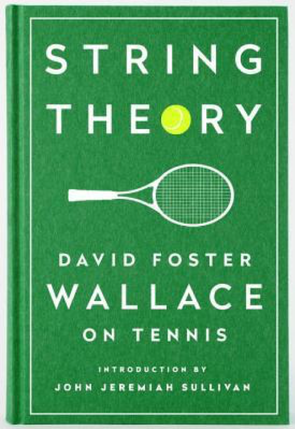
Over the years, most of us have done much more than just play tennis. We have studied it, coached it, dreamt it, talked about it - loved it and hated it. For a serious player, it’s a complex relationship. So, when a talented writer who played competitively makes the effort to decipher and describe the complex and beautiful sport, it’s special. “String Theory” shows that David Foster Wallace is capable of truly unique and insightful descriptions and analysis that are rarely discussed or read.
I wasn’t aware that Wallace is considered one of the great American writers in the past 75 years. He grew up playing junior tennis in Illinois and went on to play at Amherst College. In 2008, he took his own life after decades of chronic depression.
I discovered him when a friend sent me an essay that Wallace wrote in 2006 about Roger Federer. The article, “Roger Federer as Religious Experience, has been described by many as the greatest story about tennis. Period. High praise, I know. And I fully agree. His writing is part reporting, part biography, part philosophy and part physics (and some added comedy). The title of the book provides advance notice about what the reader is getting into.
Here are two examples from the Federer piece:
Almost anyone who loves tennis and follows the men’s tour on television has, over the last few years, had what might be termed “Federer Moments.” These are times, as you watch the young Swiss play, when the jaw drops, and eyes protrude, and sounds are made that bring spouses in from other rooms to see if you’re O.K.
Wimbledon is strange. Verily it’s the game’s Mecca, the cathedral of tennis; but it would be easier to sustain the appropriate level of on-site veneration if the tournament weren’t so intent on reminding you over and over that it’s the cathedral of tennis.
The Federer piece is only one of five from the book. My second favorite is “Derivative Sport in Tornado Alley”, which describes Wallace’s internal experiences playing high school tennis in Central Illinois in very windy conditions. He talks about weather, geometry and physics and somehow makes it all make sense. It certainly brought back nightmares of my own struggles playing in windy Spring New England conditions.
There is also a good feature on Michael Joyce’s efforts and struggles in the lower levels of pro tennis which includes detailed reporting about playing the qualies and the day-to-day struggles of the “journeyman” pro.
My bet is that most senior tennis players will find at least one of David Foster Wallace’s efforts well worth exploring. For those who love the game, this is a book that should be added to your reading list.